








Issue 25
Read
Chapter 2
The challenges, the reverses, the inspirations, and, most of all, the excitements of the eight-year adventure leading to the Grande Double Sonnerie.


What is the right term to describe a watch gestation that has lasted eight years? “Project”? Too anodyne. “Journey”? Gets closer to capturing what occurred, but “journey” implies a straight path from beginning to end with all the drama of a flight to NY—no twists or turns involved. “Adventure” resonates as it embraces the challenges, the reverses, the inspirations, and, most of all, the excitements and rewards as the design evolved. This is the story of the eight-year adventure that has led to Blancpain’s Grande Double Sonnerie.
In many ways the roots of the Grande Double Sonnerie adventure reach back even further than eight years. In the 1980s, modern Blancpain embarked on the development of timepieces representing the, then, full dimensions of classic watchmaking challenges: extra-thin, complete calendar moon phase, perpetual calendar, split-second chronograph, tourbillon, and minute repeater. Named the “Six Masterpieces” these timepieces were sold as a set. Then, as the coda to the Six Masterpieces, Blancpain incorporated all of these elements into one grand complication named the 1735. This was a limited edition of 30 pieces featuring a perpetual calendar including moon phase, split-second chronograph, tourbillon and minute repeater in a single, extra flat (taking account of all its breathtaking level of complications) automatic winding movement. For its time, the 1735 was the most complicated automatic winding wristwatch in the world.
That history from 40 years ago underlays the new Grande Double Sonnerie. Blancpain’s CEO and President, Marc A. Hayek has come to view Blancpain’s collections as forming a circle. When he took the helm, the house was principally focused on dress watches and classic complications. In the early years, he discovered more dimensions, the rich histories of the pioneering Fifty Fathoms, the world’s first true diving watch, and the women’s Ladybird, the world’s smallest round watch. This led to a broadening of Blancpain’s focus, in his words “to bring these back alive”, to complete the circle, with all of these elements of Blancpain’s history expressing themselves vividly in the collection. Having brought the Fifty Fathoms, including the Bathyscaphe, back from what had been a 20 year slumber and placing them anew on top of the world of diving watches and revitalizing the women’s Ladybird line, Hayek turned his focus to sound. Yes, Blancpain had developed no fewer than four different variations of minute repeaters: a path-blazing extra thin repeater, a repeater with automata, a repeater with carrousel, and, of course, the 1735. Yet, Hayek saw that the goal posts had moved from the era of those timepieces. The development of wristwatch grandes sonneries established a new apotheosis of sounding watches. So, Hayek determined to expand both Blancpain’s and the watch world’s horizons by not only creating a grande sonnerie, but one that would elevate the art and at the same time show Blancpain’s fidelity to its motto of “a tradition of innovation”.
If one is given to summaries taken from 30,000 feet, you could in a short phrase name the adventure “the creation of a Blancpain grande sonnerie”. However, the excitement, the challenges, the life of the project lay in the details. Of course, many of those details related to the grande sonnerie itself, but the other elements of this grand complication have their own stories to tell, which emerge as the adventure unfolds. The sonnerie, though, was the focus from day one.
Notwithstanding Blancpain’s decades long history producing minute repeaters, creating a grande sonnerie was more than a simple evolutionary step. Much more. In its basic form, chiming of the time is generally based upon two tones: a deep tone for the hours and a higher tone for the minutes. Quarter hours being composed of both tones, generally the higher minute tone followed by the deeper hour tone played once at :15, played twice at :30 and three times at :45. The first wristwatch grande sonnerie, which was created in the Vallée de Joux in 1992 by renowned independent watchmaker Philippe Dufour, followed this same script using this two tone formula. It was a great achievement when it debuted.1
From day one, Hayek wanted to go further. He wanted the sounding of the time to include a melody. That meant that there had to be more than two tones. He wanted four tones. Sounding a four tone melody would sit at the very limit of what could be achieved in the confines of a wristwatch case, as each tone would require its own striking mechanism. Thus, four tones double the complication of two. Actually, more than double, considering the challenges associated with fitting many extra components into a wristwatch sized case. As the adventure unfolds below, we shall see that Hayek came to understand that there was even a further frontier that could be added to the development.
Beyond bringing a melody to the sounding of time, Hayek at the outset added two other goals. The resulting watch had to be wearable. Some of the existing grande sonnerie wristwatches, even the two tone/ two hammer varieties were enormous in size, as much as 50 mm in diameter and 20 mm thick. A grand complication that never could be nestled under the cuff of a shirt is not really a watch. That is a “safe inhabitant”, an object brought out for show but that otherwise resides in a protected box. As Hayek puts it “there is nothing sadder than a watch which is not worn!”
The further element was a bit harder to define, but vital nonetheless. In his words, “the watch had to make you smile.”
So here was the initial challenge which Marc Hayek laid down for the movement design team: a grande sonnerie with the functions grand, petite, and minute repeater; a complex melody with four tones; all to fit into an easily wearable watch case. And the “smile”.
Normally a watch development project starts and continues in a rather straightforward fashion to its conclusion. As Hayek describes this grande sonnerie adventure “every time he lifted the lid to see what’s there, something new came out”.
¹ Actually it can be powerfully asserted that the 1992 Grande Sonnerie from Dufour was not the first grande sonnerie built in the dimensions of a wristwatch. That crown belongs to Blancpain! In 1892 Louis-Elysee Piguet, the father of the Piguet line in the Blancpain family tree, created a women’s grande sonnerie pocket watch with a movement diameter of 32 mm. Piguet’s pocket watch was converted to a wristwatch in modern times, as the dimensions of the movement were fully compatible with a wristwatch case.
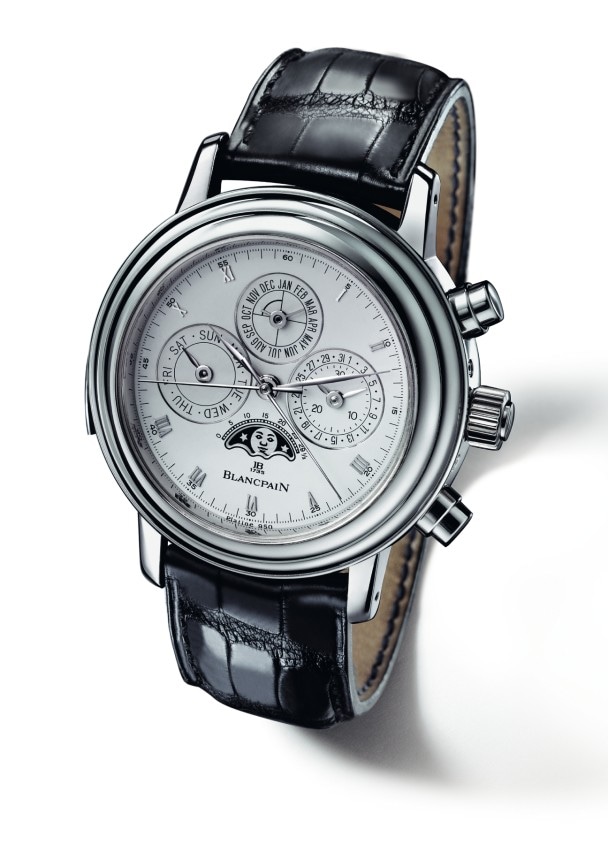
Blancpain’s GRAND COMPLICATION from the 1980s was the 1735, which for its time, was the MOST COMPLICATED AUTOMATIC WINDING wristwatch in the WORLD.
The initial efforts were devoted to sound and, in particular, how to enhance the transmission of the sound from the movement to the exterior of the case. It was not just a question of the volume of sound that would be emitted from the case, but also the frequencies, verifying that the tones would be transmitted with full fidelity.
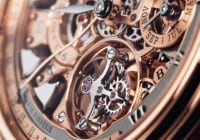
However ambitious the goals for the sonnerie may have been leaving the starting gate, Hayek was to elevate the project even further as he considered other elements to be incorporated into the watch. Early on, attention turned to the core timekeeping element. At Blancpain there were two prestige designs from which to choose, each of which was a world first: Blancpain’s signature flying tourbillon, the first flying tourbillon for a wristwatch, or the carrousel, the first flying carrousel for a wristwatch and, today, still unique in the world of fine watchmaking. Both offered superior timekeeping performance, ameliorating rate errors caused by gravity. Intensive design evaluation led to the conclusion that the tourbillon configuration was better adapted for mating with the sonnerie. Still, Hayek saw room for improvement as the frequency of the established tourbillon design was increased to 4 HZ.
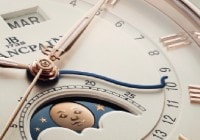
Next, Hayek “lifted the lid” on another element, which in turn, set the course for a further challenge. The 1735 patrimony pointed in the direction of adding a perpetual calendar. He set the bar higher. All the other grandes sonneries that included a perpetual calendar did so by adding to the base movement a separate plate bearing the calendar mechanism built as a module. Hayek wanted a more elegant approach. Rather than the traditional sandwich construction of multiple plates, the movement should be one that was fully integrated. That is to say, the calendar, instead of being constructed as a module, would be completely incorporated into the movement eliminating the need of a separate plate. The goal was not to set a world record, rather Hayek saw it, as part of the initial “wearability” imperative. Avoiding a separate plate would make the timepiece slimmer. This meant, however, not only finding a space for the calendar components among the other movement elements, but a place on the dial as well for all the perpetual indications: date, month, day of the week, and leap year. In its repertoire, Blancpain had a rich range of perpetual calendar designs, none of which could be integrated into the new timepiece.
Months of work were devoted to feasibility studies for the general layout of the movement. How to integrate a perpetual calendar. How to place the four sonnerie hammers dial side. Where to locate the tourbillon. These studies led to an entirely new concept for the calendar. To fit within both the movement and the dial, the date would be displayed by a retrograde hand. At the end of each month, the hand would rapidly return to the indication of “1” for the start of the next month. Not only did this approach allow for an easily readable date display, it would leave view of the underlying elements of the watch… sonnerie hammers and the tourbillon… unobstructed. And one more thing. For months shorter than 31 days, most perpetual calendars have to pass through to “31” before reaching “1”. Thus, for a February of 28 days, late at night, the date hand has to progress through 29, 30, and 31 before “1”. Retrograding eliminates these fictitious dates as the hand would return to 1 directly at the end of a short month such as February.
With general concepts becoming defined, 2015 turned to the details on multiple fronts.
For the sonnerie, two critical elements emerged. From the year-long studies on the transmission of sound from the movement to the exterior of the timepiece, Blancpain invented an innovative bezel design. Giving the bezel a degree of vibration freedom and fitting within it a uniquely configured sound membrane served the dual goals of volume and quality of sound. This design is the subject of a patent.
To ensure that the striking tempo remains constant, every sonnerie requires a regulator to establish a pleasant and precisely regulated tempo. This is particularly demanding when the sounding includes a melody. Classically, sonnerie regulators emit a muted buzzing noise, the best of them barely perceptible. Blancpain’s design team went further turning to a completely silent regulator that utilizes rotating metallic elements in a magnetic field. Its silent functioning eliminates any trace of sound that would compete with the sound of the chiming. The magnetic regulator is patented.
Meanwhile other movement constructors devoted themselves to the details of retrograde perpetual calendar design. Two patented elements emerged from this work.
Universally throughout the watch world, for almost all watchmaking designs and complications, powerful software carries the day. Yes, of course, the constructions emerging from the computer have to be validated, but the CAD is always at the core.
Sound is something else altogether. Trial and error moves to the fore. So it was for this grande sonnerie. Multiple studies were launched. What material for the sounding rings? Steel? Sapphire? Ceramic? Gold? Then what cross section? Completely round or with additional shapes? What fixation points? Every one of these variables was tested. Among the unquestioned rules in watchmaking is that there is no set formula for designing a sonnerie. In some ways, it is a black art. These are all difficult questions to answer with a “simple” two tone minute repeater. They are exponentially more challenging when sounding a melody, as the sound has to have soul.
Then came the question of melody. The most famous time telling melody in the world is London’s Big Ben. Watchmakers term its melody “Westminster”. This is the favored melody for elaborate chiming clocks, so it was a natural first candidate. Indeed, Hayek says it was the “baseline” and he “never thought of anything else”. Until he did.
Steering the entire adventure onto a revolutionary new course, Hayek had an inspiration. The Westminster was to be a pillar for the timepiece, but why not have a second melody? That had never been seen in a wristwatch grande sonnerie. He pushed his idea even further. Why not provide for the owner to select back and forth between two melodies via the push of a button?
A long-time friendship brought about the second melody. Superstar rock musician Eric Singer has been close to Blancpain and Marc Hayek for more than a decade. He pounced at the chance to compose the second melody. There were limits, of course. Couldn’t do a rock riff or, as Hayek puts it pithily, for that matter a “Frank Sinatra” tune. Singer would be limited to the four tones and the tempo brought to the first melody. Calling the task “fun” Singer set about composing. More than a few times he begged to write a long tune. Working in his studio he penned 10 candidate melodies. Together, Singer and Hayek settled on one of the Singer melodies as the second melody alongside Westminster. Naturally, this was named the “Blancpain melody”.
One more new twist was added. The depth of innovation of this timepiece was exceptionally profound. No fewer than 21 patents emerging from the adventure.Without question, the quality of finishing had to live up to the level of mechanical excellence. The décorateurs were to pour their hand-finishing talents onto the movement, even to those components completely hidden to the owner that would only be seen by the watchmaker assembling the timepiece. Notwithstanding the gleaming finishes that marked the first efforts with the mainplate and bridges carried out in rhodium plated brass (the standard in the watch world), Hayek wanted to bring added sophistication to the appearance by changing the material to red gold. Two colors were envisioned: the natural red gold hue or red gold with rhodium plating.
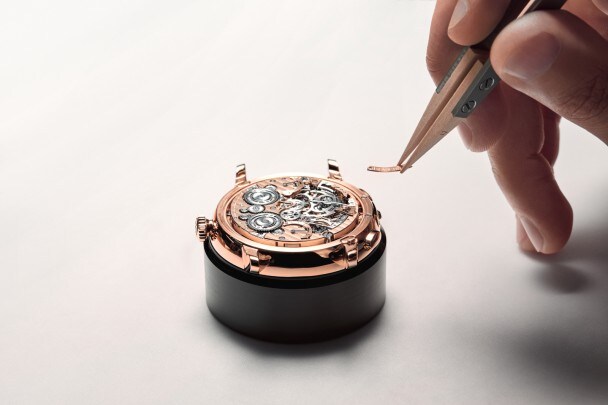
A final touch. The insert bearing the Blancpain signature on the visible side and that of the watchmaker on the back side.
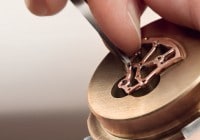
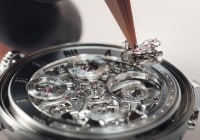
There is a chasm to be traversed following the end of the design phase and the production of any truly new timepiece. That gulf is mammoth in the case of grand complications. Specialty tools have to be conceived in order for the watchmakers to be able to finish the components and assemble them. Much of this work takes place in the prototype phase as the needs for particular tools are identified. This is also the time for the education and training of the watchmakers on the special skills needed for a timepiece this complicated.
Final aesthetic and functional decisions wove themselves into the process. Marc Hayek immersed himself into all the details of the prototypes identifying refinements before giving the go ahead. There are only two watchmakers who will be assembling this new grande sonnerie and only a maximum of two per year produced. Each watchmaker will work on a timepiece from beginning to end, or as it is often expressed “A to Z”.
As it embarked on this eight-year adventure, it would have been easy for Blancpain to conclude that it could signal its devotion to high watchmaking and its determination to advance beyond the legend of the 1735 by creating a two-tone grande sonnerie. It did not have to design a four hammer, four-tone sonnerie capable of playing a melody. It did not have to endow it with two melodies selectable via a button. It did not have to fit an evolved higher frequency version of its emblematic tourbillon. It did not have to create an entirely new retrograde perpetual calendar fully integrated into the movement. It was not necessary to fashion the mainplate and bridges in red gold. There was no necessity to develop 21 patented features for the movement. Those were the paths chosen because the Grande Double Sonnerie became more than a watch to build and sell. It became and is now a shining monument to fine watchmaking.
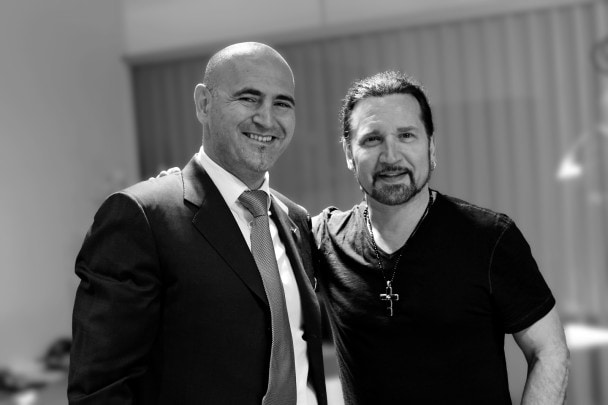
A long-time friendship between Marc A. Hayek and SUPERSTAR musician, Eric Singer, brought about the SECOND MELODY.

Chapter 03
Atop the pyramid of grand complications stands the Grande Sonnerie.