












Issue 25
Read
Chapter 3
Atop the pyramid of grand complications stands the Grande Sonnerie.


Grandes sonneries, petites sonneries, minute repeaters. What do they have in common and, importantly, what are the differences? The commonality is easily defined; they all announce the time with sound. As well, it is worthwhile mentioning that all occupy the most elite and rarified perches at the top of fine watchmaking for they combine the most demanding precision in the construction of the key sounding mechanisms with artistry, some would say even poetry, in the production of sound.
Grandes and petites sonneries distinguish themselves from minute repeaters in that their sounding of time occurs in passage. No action is required by the owner. Instead, the sounding will occur automatically as the watch passes defined points in time usually on the hour and on the quarter hours. Watchmakers term this “au passage.”1 Although grande and petite sound the hour on the hour, there are differences between the two which we describe below. In sharp contrast, a minute repeater only sounds the time when the owner takes action to command a sounding.
How is the time signaled? Better said, how does the watch audibly compose the time as shown by the hands? In the case of classic minute repeaters, when the owner commands that sounding occur, the chiming mechanism, from the running train of the watch, mechanically “reads” the current hour, the current quarter hour, and the current minute as shown on the dial. Common practice audibly composes the time using two tones, one with a low musical note (for convenience let’s term this “dong”), the other a higher musical note (likewise for convenience let’s term this “ding”). The hour is chimed first with the low musical dong note. Next are the quarter hours using a combination of both notes—ding/dong. Finally, the minutes using the high note ding. In each case the number of strikes signals the time. Take an example of the command occurring at 5:53. The minute repeater would signal the hour with five strikes of the low note (dong, dong, dong, dong, dong), followed by a strike of the high note and immediately the low note with the combination repeated three times—ding/dong, ding/ dong, ding/dong (that is to say three quarters i.e. :45), concluded by eight strikes of the high note ding, ding, ding, ding, ding, ding, ding, ding (as :53 is 8 minutes after :45). What happens in the first 14 minutes after the hour as the first quarter has not yet occurred? Most minute repeaters sound the hour, insert a pause as the first quarter hour hasn’t arrived, and then sound the minutes. In a moment we will turn to a refinement for chiming during the first 14 minutes. Since the owner can command the sounding of a minute repeater at any time, the movement will read and sound to the exact current minute.
1 The terms “au passage” and “en passant” are often used interchangeably.

Grandes and petites sonneries are different. In the case of a grande sonnerie, the chiming occurs as each full hour and quarter hour passes. In the most straightforward form, a grande sonnerie (one might be tempted to say “the most simple” construction; however, no grande sonnerie is simple) the composition is like that of a minute repeater as the hour is chimed with the low dong notes and the quarter hours sounded with chime dong, dong for. Example: at 2:30 this form of grande sonnerie would chime dong dong for the hour 2 and ding/dong, ding/dong for :30, that is to say two quarters. One key element: to qualify being classed as a grande sonnerie, at each quarter hour, the hour sounding must occur first in the sequence followed by the chiming of the quarters. That is to say, the hour chiming always precedes the quarter chiming.
One would imagine in watchmaking, a milieu obsessively devoted to precision, that terminology would run in parallel echoing that exactitude. The term “petite sonnerie” deviates from that time-honored norm in that the definition of “petite” seems to reveal a certain flexibility or fuzziness. Or, said another way, some petites sonneries are more petite than others, yet they bear the same descriptor. The “most petite” petites sonneries only chime the hour on the hour. No quarters are sounded at all. Others, also calling themselves “petite,” chime the hour on the hour and chime :15, :30 and :45 without chiming the hour before the quarters. Contrast a grande sonnerie with this variety of petites. At 2:30, a grande sonnerie would chime dong, dong followed by ding/dong, ding/dong. A petite would chime ding/dong, ding/dong. Of course, the first variety of petites would chime nothing at all at 2:30.
So far we have drawn the contrast between the minute repeater and the two varieties of “au passage” sonneries in the composition of the chimes. There is an even deeper divide in the constructions. In the case of classic minute repeaters, the energy for a sounding event is supplied by a small barrel spring which is charged by the owner’s act of pulling a slide or, in some cases, pushing a button. For both grandes and petites sonneries, the energy for the chime is supplied by the movement itself. Most constructions accomplish this by fitting the movement with two barrels: one barrel for the running train of the watch, the second barrel for the sonnerie; both generally are wound via the crown.
Although the category of grande sonnerie does not admit of the same degree of flexibility as is the case of the petites, there are elaborations which elevate the grande sounding to a higher and more sophisticated plane. As one would expect, these elaborations are accompanied by exponentially greater complexity in the movement. A short tutorial on chiming constructions. In the distant past, the era of early pocket watches, time was sounded in two ways: either a non-musical rapping of a small hammer on the caseback or musical notes produced by a small hammer tapping on a bell. There were profound disadvantages to both these historical methods: the crude sound of the caseback variety or the awkwardly thick constructions of the bell genre. All of that changed when legendary watchmaker Abraham-Louis Breguet revolutionized sonneries by producing musical tones with a small hammer striking against a metallic ring circling the movement.
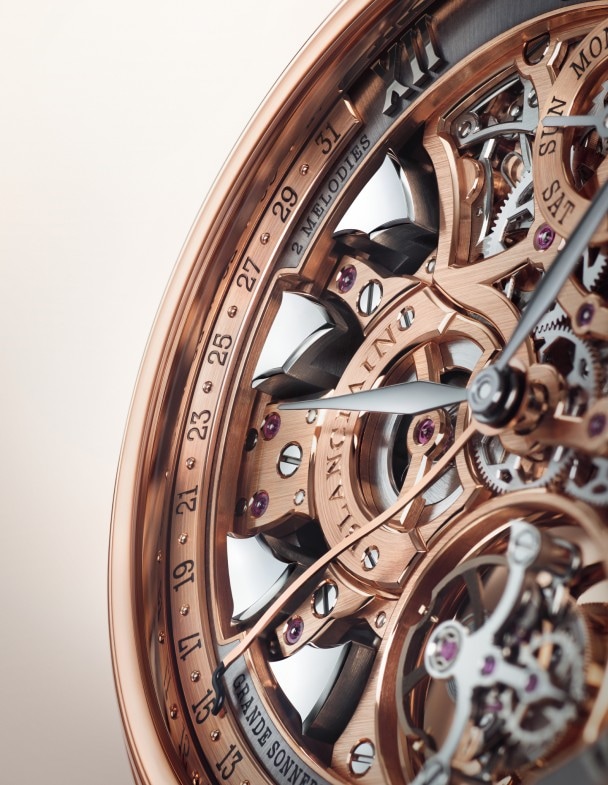
The four hammers of the sonnerie.
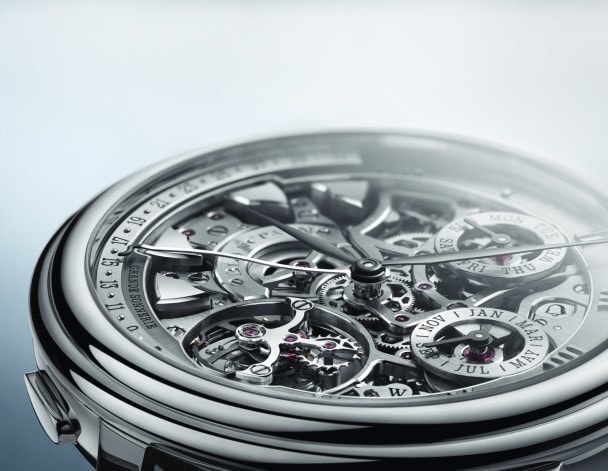
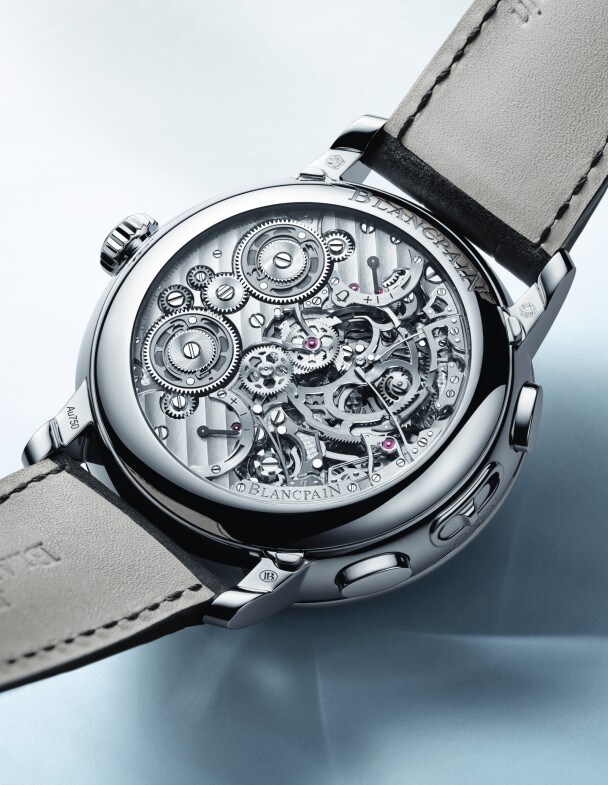
This inspirational advance combined musicality with thinness. Each tone is generally produced by one hammer and its associated metallic ring (often termed a “gong”). Thus, for the “ding” “dong” sonnerie varieties discussed above, there would be one hammer and gong combination for the “ding” and a second hammer/gong for the “dong”. Today, this advance has become universal and reflected in essentially all sonneries.
Today the norm for grandes sonneries, petites sonneries and minute repeaters is the two tone—“ding” “dong” variety built using two hammers each with its associated gong. However, there are leading edge designs that go beyond the two-hammer, two-tone construction. With more hammers enabling additional tones, new frontiers are opened as the sounding can transcend two tones and enter the domain of true melodies. Naturally, the degree of complexity of the movement increases dramatically as additional hammers and gongs are added. As we shall see in the article “Two Melodies” there is an even higher plane when the sonnerie is designed to offer more than one melody.
There are other possible sophisticated elaborations. Pre-existing wristwatch grandes or petites sonneries, on the hour, chime only the hour. To bring added importance to the passage of the hour, it is possible to chime not only the hour, but all four quarters.
For the owner, the chiming of four quarters on the hour offers the occasion to hear a melody in full. Although this elaboration at first blush appears simple, it is technically a tour de force as it consumes considerably more energy from the sonnerie barrel, thus, requiring a studied design to enable this extra energy storage.
The minute repeater function also can be refined. In the case of almost all minute repeaters, when a chiming is commanded during the period between the full hour and 14 minutes, that is to say when no quarter hour could be sounded, there is a pause between the sounding of the hour and the commence-ment of the sounding of the minutes. That pause represents the period when a quarter hour would be sounded if the time were between 15 minutes and 59 minutes. That period is termed by watchmakers as a “phantom quarter”2. Instead of the insertion of this quiet period, a more advanced design proceeds directly from the sounding of the hour to the sounding of the minutes, eliminating the “phantom quarter”.
In the distant past, grandes sonneries and petites sonneries were the exclusive province of massive city or village church clocks. Their sounding of time, au passage, regulated the lives of the citizens living within listening range of its chimes. It is no less than a miracle of miniaturization that the same enchanting sounding of time has been brought to the wristwatch.
2 Sometimes this is termed “temps mort”.

Chapter 04
When the sounding of time was paramount.