














Issue 25
Read
Chapter 9
Blancpain’s flying tourbillon construction: A signature of the house.


The tourbillon is one of watchmaking’s most revered inventions, one that addresses small rate errors to which every watch is subject. These are errors in the form of perturbations caused by gravity and friction which produce slight increases in rate with the watch in some positions, slowing in others. The breakthrough occurred when Abraham-Louis Breguet invented the tourbillon which he patented in 1801. His inspirational design addressed these small errors by taking the key rate keeping elements of the watch—its balance wheel, hairspring, and escapement—and placing them within a carriage. By rotating the carriage constantly, these rate errors compensate for each other as the timekeeping components are rotated through both fast and slow positions.
All of the wristwatch tourbillon designs prior to 1989, which numbered fewer than even a mere handful, suspended the tourbillon carriage and its components between two bridges, top and bottom, with an axis inserted into jeweled bearings fitted into each of the bridges. Although effective, this construction had the disadvantage of the top bridge covering a portion of the view of the rotating tourbillon beneath it. Blancpain refined this architecture by removing the top bridge, supporting the tourbillon entirely from its lower bearing. This design termed “flying” placed the fascinating symphony of motion of the rotating carriage, oscillating balance wheel, and escapement in full view, unobstructed by a bridge. Considerably more demanding in its construction, this Blancpain flying design was a watchmaking first. Indeed, its 1989 debut advanced the art in three respects, as not only was it the first serially produced wristwatch flying tourbillon, but it was also the thinnest and offered the longest tourbillon power reserve.
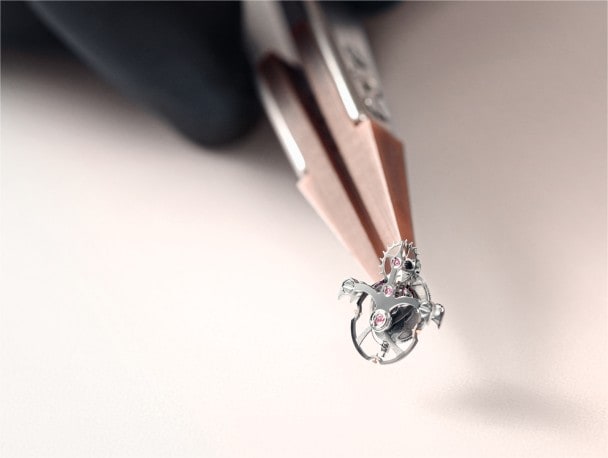
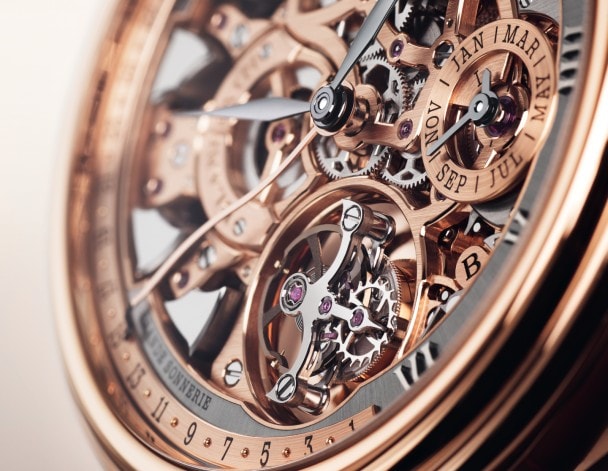
To enhance the visibility of the symphony of its motion, the tourbillon assembly is elevated above the level of the encircling bridge.
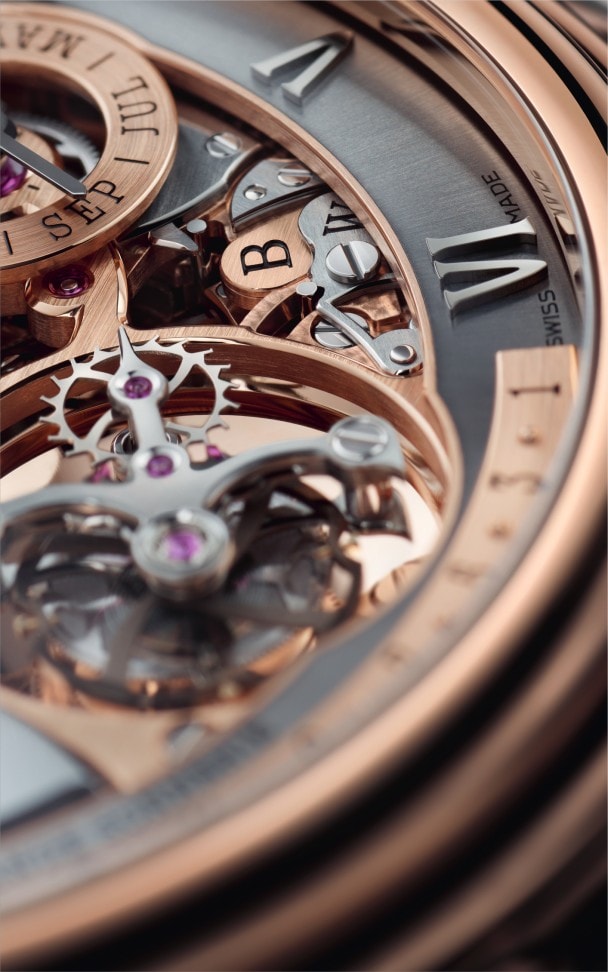
Since its introduction, Blancpain’s flying tourbillon has become emblematic for the house. The Grande Double Sonnerie offers further enhancements to this icon. Its frequency has been increased from 3 Hz to 4 Hz. Its spiral is now fashioned in silicon which resists magnetism. In addition, this material offers three additional attributes improving chronometric performance: lighter weight, idealized shape, and more constant amplitude as the mainspring force changes. To enhance the view of its complex motion, the tourbillon has been slightly elevated above its dial-side porthole.
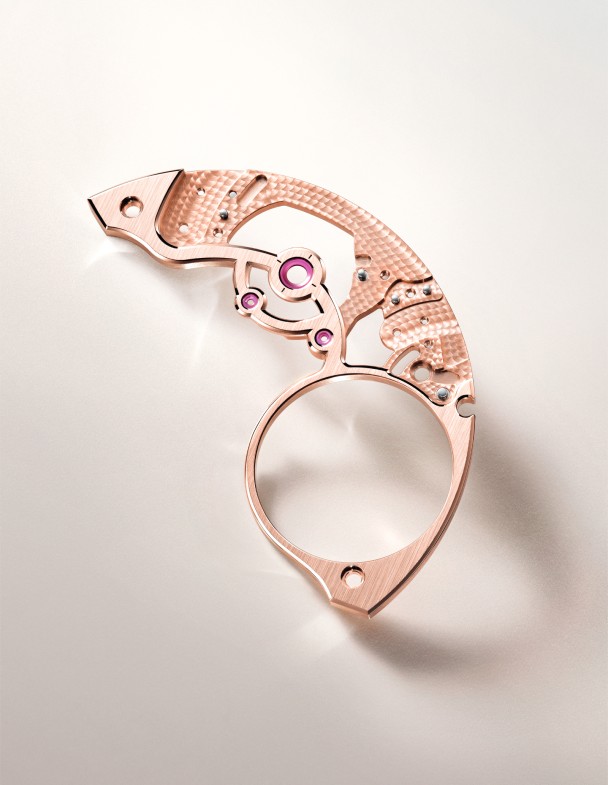
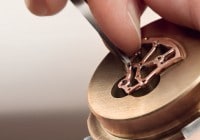
The tourbillon bridge. Note the finely applied finishes to the section entirely hidden from view once the watch has been assembled.

Chapter 10
Protecting against misuse or momentary forgetfulness.