









Issue 25
Read
Chapter 5
The watchmaking challenges of sounding a four-tone melody on the quarter hours.


In silent reverence, the glass is approached. Tilted. Held to the light, the edge examined. Swirled, deeply sniffed, a sip, aerated on the tongue. Deep in thought another sniff, sip, aeration, a long contemplative swallow. Then the verdict: deep garnet color, no brick, an open explosive nose offering exotic spices (cloves, cinnamon, touch of pepper), full on the mouth with bright focused red and black cherries bursting forth laced with toasted vanilla, sweet long finish. How can one be a taster of fine wine without a basket of adjectives at the ready?
When it comes to evaluating chiming watches, there is a ritual of similar kind, absent of course the sniffs, sips, aerations and swallows. Although the gestures and methods may have no counterparts, the reverence and focused concentration are the same. To be true, very few watch aficionados ever get to experience, savor perhaps a better word, the sounding of a prestige minute repeater. There are, however, connoisseurs who wax with the same poetry about the sound of a classic two tone minute repeater as our wine expert on fine burgundy. Words like “clarity”, “brilliance”, “resonance”, “richness”, and “persistence” peppering their commentaries.
Everything changes when the sounding moves from a two tone “ding” “dong” (high tone ding and lower tone dong) sonnerie to a melody. In the case of a classic two-tone sonnerie, the low tone sounding the hours, the high tone the minutes, and the combination high tone/low tone the quarters, there is considerable latitude on the frequencies (pitch) both with respect to each tone taken individually and the relationship when they sound closely together for the quarters. Playing a four tone melody is a different world entirely. First, as is the case for every musical score or tune, the actual notes must precisely hit the marks for the composition. The Westminster melody begins “Mi, Sol, Fa, Si” . As a musician sings or plays in tune for each note, same for the sonnerie sounding a melody; all of its notes in tune in like manner. It is not a stretch to think of a concert master bringing an orchestra together, or said another way, “in tune” by playing a note, usually an “A” sounded first by a wind instrument, usually an oboe whose pitch is stable. Contrast a standard two-tone repeater where there is great flexibility for both the pitch and even the octive. Not only must the pitch be correct for each note, “musicality” becomes important. When, for example, a violinist plays a note, the sound is actually composed of several frequencies: the main frequency and surrounding harmonics which are essential to bring richness to the sound. Absent those harmonics, the note would sound harsh and hollow. This holds true for a sonnerie sounding a four tone melody; each of the four notes must not only be precisely sounded in tune, for lush musicality, the presence of enveloping harmonics becomes essential. Tempo imposes a further set of requirements when playing a melody. Whereas there is leeway with respect to the pauses between the tones of the repeater as long as they are reasonably consistent, a melody is far more exacting, particularly as its sounding is longer with more notes. Once the tempo is established, the ear is sensitized and conditioned to the expectation that the pace will continue without deviation.
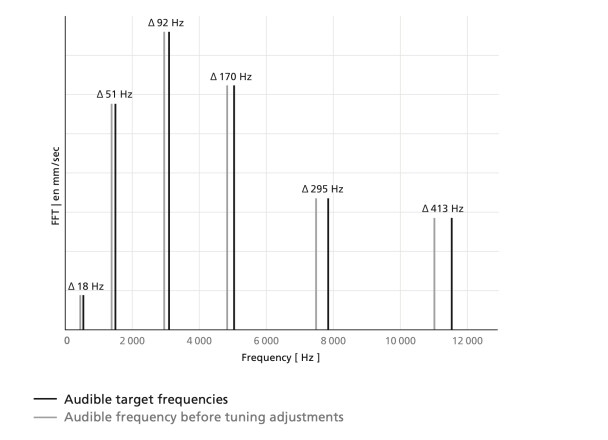
An example of the tuned frequency response of a gong. On the quarters, unlike a standard two-tone sonnerie, playing a four-tone melody requires precise sounding of the correct frequencies for the notes, each one verified by laser.
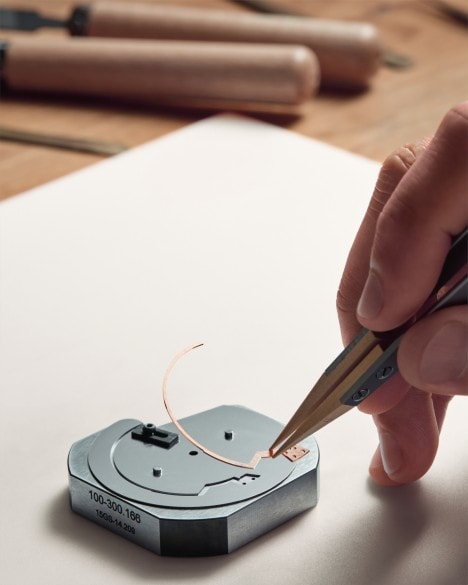
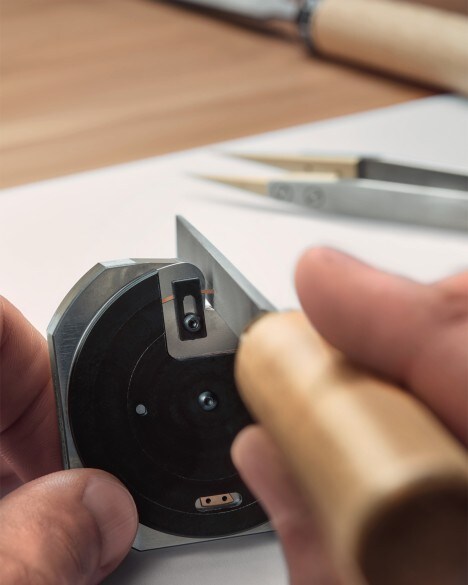
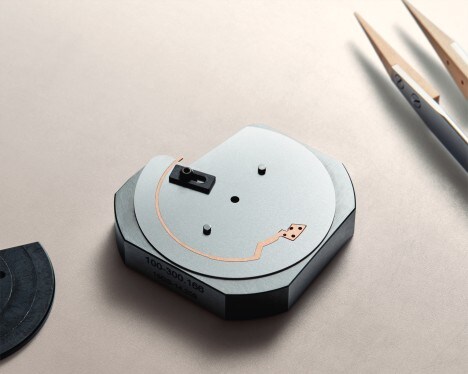
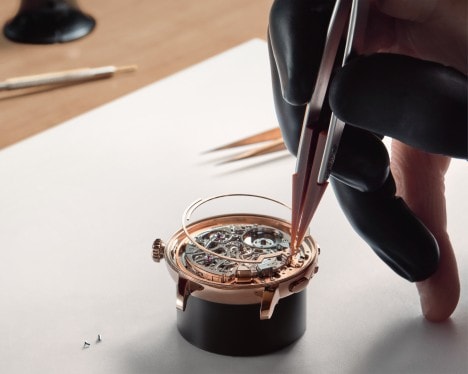
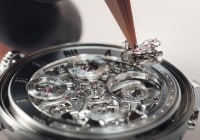
Fine micro adjustments of the gongs by the watchmaker are necessary to sound the frequencies perfectly.
THE NOTES
Blancpain’s Grande Double Sonnerie is the first wristwatch to offer two different melodies, “Westminster” and “Blancpain”, which at the touch of a pusher, can be selected and switched back and forth by the owner. Although the two melodies are unique, they both are comprised of the same notes and played at the same tempo. The challenge for the movement designers was designing the movement to sound the notes at the correct pitch and play them at the desired consistent tempo. A concert master may think of “Mi” as a pitch (note and octave); a movement designer has to be a bit like the oboe player sounding a stable note matched by the concert master’s violin. The oboe is in fact sounding a frequency and it is exact frequencies that the Blancpain movement designers targeted for each of the Grande Double Sonnerie's four notes. The frequencies chosen not only had to match the four musical notes of Mi Sol Fa Si, they had to fall in the frequency range most easily heard, that is to say, not too high nor too low.
The task then turned to producing the notes correctly and precisely. To understand the process, a touch of sound engineering. A mechanical sonnerie produces a note, or as we are now speaking, a frequency, through vibration. All modern mechanical chiming watches owe their fundamental design to Abraham-Louis Breguet’s inspirational invention of a system featuring small hammers striking sounding rings so as to produce an audible vibration. Blancpain’s designers confronted the task of developing the right combination of hammers and rings which would perfectly vibrate to form each of the four notes. There are no texts, no tables, no set formulas that yield the right answers. Instead, trial and error became the order of the day. Which material for the rings? Steel? Crystal? Sapphire? Gold? Which cross section shape? Round? Square? Uniform shape or variable profile? What length? Where upon the gongs should the hammers strike?

A final moment after 12 months devoted to assembling the Grande Double Sonnerie which will bear his name, the watchmaker verifies the sound.
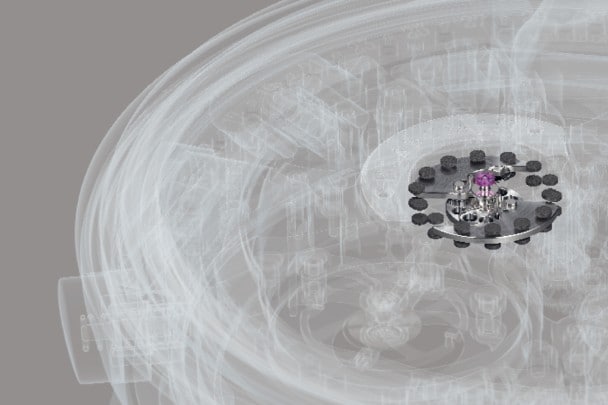
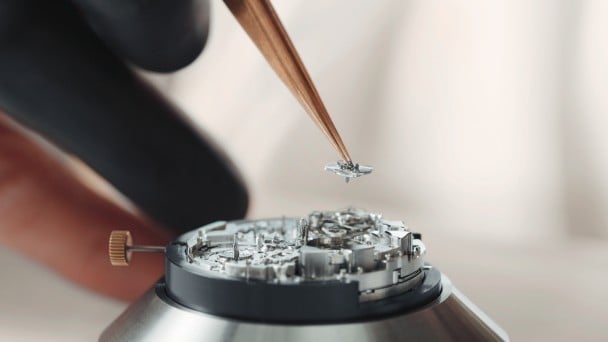
Precision in the tempo of the sounding is essential. A vital component to achieving that goal is the magnetic regulator.
Additional factors came into play. First, when a metallic hammer strikes the sounding ring, it triggers vibrations of multiple frequencies. Hopefully, of course, the target frequency for the desired note, but, in addition, other frequencies that are harmonious with it and that endow the sound with richness (termed “partials”). Inevitably, there will be some others out of the audible range.
Early on, gold was selected as the gong material. Transmission is enhanced when the sounding rings and the case within which they are housed share the same composition. What followed were countless trials testing different profiles and lengths. These tests yielded rectangular profiles, thicknesses and lengths optimized to produce each of the four notes. Adding to the complexity, the designers found that varying the cross-section profile along the length of the gongs became key to the sounding. The shapes of the profiles play an important role in achieving a rich musical sound with well placed harmonics. This variable profile of the gongs is a subject of a Blancpain patent. For each of the notes, fine adjustments in the length of the gongs, on the order of microns, are called for to hit the right frequencies; as a gong is shortened during tuning by the watchmaker, the frequencies of the main note and the harmonics increase together. In order to validate that each of the tones was precisely sounded, think of our concert master tuning the orchestra, Blancpain’s watchmakers employ a laser to measure the frequencies accurately. The tolerance is miniscule as tuning is done to within 5 HZ for each note. Voila, the tuning of a grand sonnerie via means other than an oboe and first violin.
Much more came into play. Who would prize a sonnerie if the volume of sound were difficult to hear? Just as the notes produced by the sounding rings are vibrations, so is the sound transmitted from the case and the crystal, with those elements vibrating and broadcasting those gong vibrations as sound into the air. The search to maximize the volume led to a patented invention: a red gold membrane solidly attached to the crystal and nestled under the bezel, which, in turn, was given a degree of freedom to vibrate. The membrane’s function is to pick up the vibrations from the movement’s gongs and to act somewhat as a loudspeaker, amplifying and diffusing the sound from the vibrating rings to the watch crystal and bezel. Ordinarily, the crystal and bezel of a watch operate to attenuate lower frequencies. The result: a degree of harshness in the sound as the higher frequencies come to dominate. The patented membrane addresses this problem as it emphasizes the desired lower register sounds while at the same time filtering the less desired higher frequencies.
Tempo received the same obsessive search for perfection as the notes themselves. Just as the notes must be precisely sounded in order for the melody to play correctly, likewise the time intervals between the notes must be exactly spaced. To a degree, standard minute repeaters strive to achieve a consistent tempo employing a device known as a “regulator” or sometimes termed “governor”. The regulator’s function is to modulate and control the pace of the movement components that activate the hammers of the sonnerie. If the barrel spring that powers the repeater mechanism has a tendency to rotate the components too rapidly when its torque is at its maximum at the beginning of a sounding, the regulator operates to slow it down.
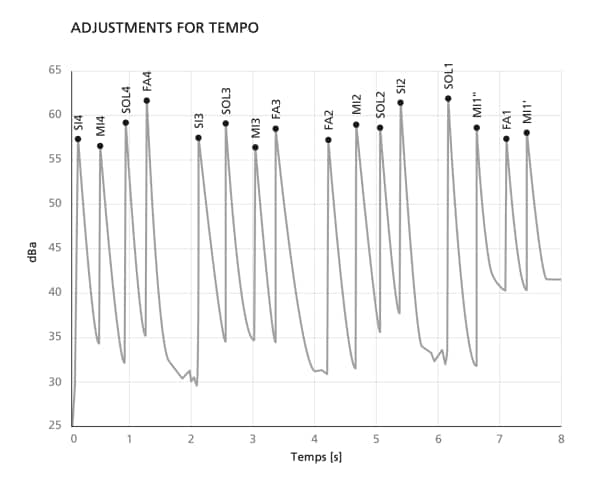
The tolerance for the tempo sounding is 5/100th of a second measured and confirmed by an acoustic recording.
The opposite also. As the sounding progresses and the barrel unwinds, its torque drops. As this occurs, the regulator reduces its drag on the system hopefully allowing the pace to be maintained. Throughout the watch world, there have been two basic forms of regulator design: an “anchor” or “recoil” construction where a small-spring loaded click engages and releases against a rotating deeply-toothed wheel, the combination acting somewhat like a watch’s escapement to set the rate, and a “centrifugal” approach where rotating elements are pressed against a housing, generating more friction if rotation tends too rapidly, reducing friction as rotation slows. Both of these designs inevitably emit sound which competes with the notes produced by the hammers and gongs. Generally speaking, the anchor design generates more noise than centrifugal systems.
Blancpain has employed a cutting edge advancement over preexisting designs by fitting the sonnerie with a patented magnetic regulator. This innovative construction utilizes small magnets that operate on rotating elements. As the speed of rotation begins to increase, the centrifugal forces draw the elements outwards where they encounter increasing magnetic resistance. The reverse occurs as the rotation speed begins to slow and those elements are pulled inwards via springs into the zone where the magnetic resistance is lower. The effect is to maintain a constant rate notwithstanding the change in torque as the barrel unwinds. The advantages are considerable. The magnetic regulator is completely silent. As well, its regulation is more precise than either of the pre-existing approaches. Finally, it consumes as much as 50 % less energy than the standard constructions.
As important as the rate regulating system may be, playing a melody calls for even greater control of the tempo. This is particularly true of Blancpain’s Grande Double Sonnerie, as on the hour in all sounding modes (grande, petite, répétition) it chimes all four quarters. All of the other wristwatch sonneries sound no quarters at all on the hour. Their longest duration quarter chiming occurs at :45, which is three quarters. Thus, Blancpain distinguishes itself from those that have come before by offering the longest playing of quarter hours.
The central component to the playing of the melody, which occurs every 15 minutes (on the hour, :15, :30, :45) bears the entirely logical name “pièce des quarts” (quarter hour element). It is fitted with teeth that activate the hammers, in succession, in the order of the notes called for by the melody. Although the magnetic regulator controls the motion of the pièce des quarts, in order for the notes to sound at precisely the right instant, the watchmaker assembling the timepiece has to make exceedingly fine adjustments to both the teeth of the pièce des quarts and the tips of the component attached to the hammers termed the levée. When the tooth of a pièce rotates past the tip of a levée, it causes the levée to rotate so that its attached hammer strikes the gong. The strike occurs at the instant when these two elements meet; the timing of that instant is a key element of the tempo. Thus, in addition to requiring a regulator which offers more precision than anchor or centrifugal systems in the speed of the pièce rotation, Blancpain has focused on the tolerances in the positions and shapes of the teeth and tips which also affect the tempo. The human ear is miraculously sensitive to tempo, discerning rhythms to mere 10ths of a second1, all the more so when the sounding is extra-long on the full hour. Blancpain’s standard is a tolerance of five one hundredths of a second! This calls upon the watchmaker to make fine adjustments to the teeth and tips on the order of microns! The result: a perfectly paced melody.
None of this is to diminish in the slightest the extraordinary craft required to produce a minute repeater of breed. Rather it is to demonstrate the orders of magnitude greater challenges of playing a melody.
1 A compelling demonstration of the human ear’s ability to discern minuscule variations in tempo, is Steve Reich’s “Clapping Music” where four musicians create intriguing sounds by varying, on the order of microseconds, the phases of hand clapping.
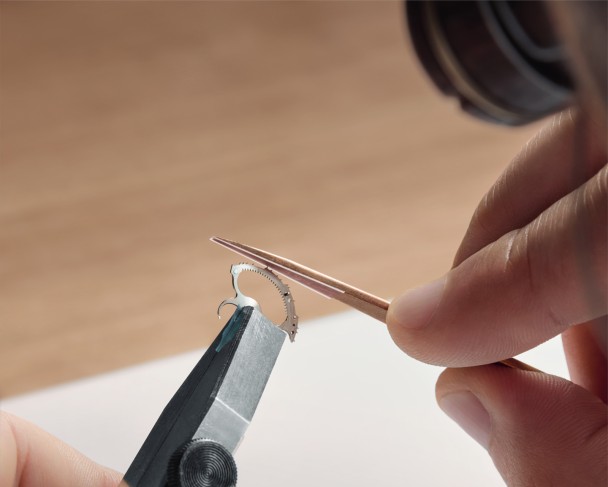
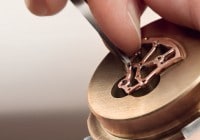
Fine adjustments of the teeth of the pièce des quarts, on the order of microns, are made by the watchmaker to fine tune the sonnerie’s timing.

Chapter 06
How to fit two complex melodies into the confines of a wearable case.