

















Issue 25
Read
Chapter 15
From French Roots to Southeast Asia to the Western Pacific. From Somewhere to Everywhere.


Still from somewhere and now a bit from everywhere. How does one describe a restaurant with its roots in one of the most remote, some might say nearly isolated, corners of deep rural France, that has chosen to locate in Asia’s most dynamic multi cultural city and that casts its nets throughout Southeast Asia and the Western Pacific Region for influences and ingredients? Somewhere. Everywhere.
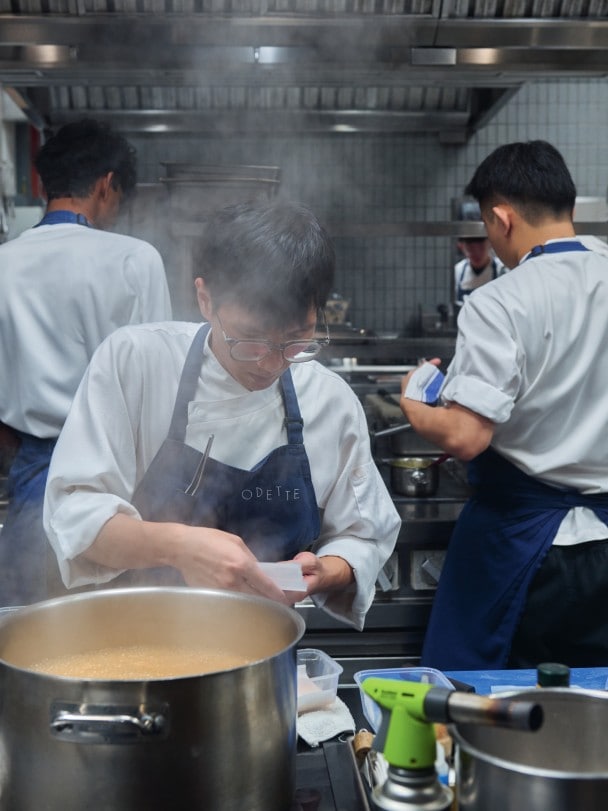
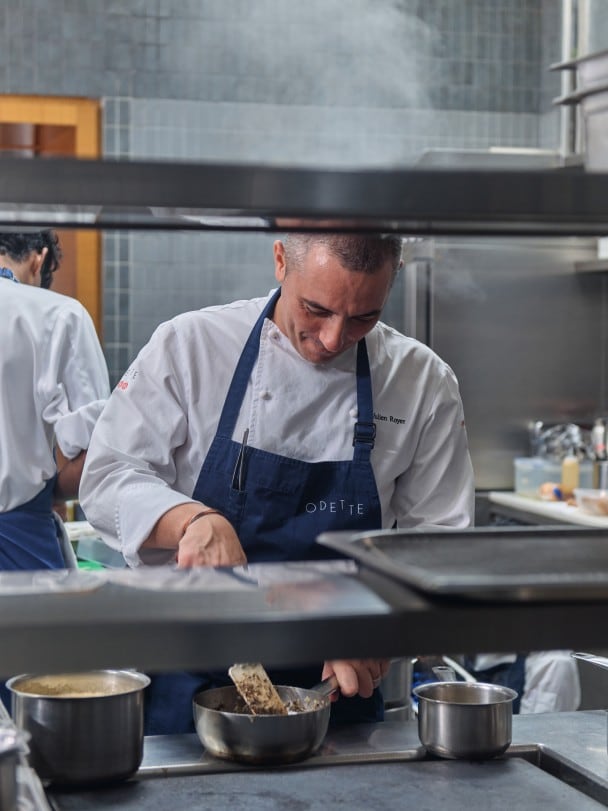
Chef Julien Royer was raised in Cantal, France, a postage-stamp sized village in the center of the Auvergne. It is no exaggeration to say that the Auvergne is the most sparsely populated department in the country, lacking even one population center that could claim to be a city. Its villages are scattered, separated by rugged terrain and joined by difficult narrow twisty roads. Royer’s upbringing was on a farm. His inspirations to become a cook came from his grandmother, Odette, who is honored in the name of his first Singapore restaurant. From her he learned respect for fresh ingredients sourced locally. As Royer expresses it, thanks to the richness of Auvergne agriculture, including the family farm and the abundance of local poultry, livestock and game, “he always knew where every ingredient came from”. Most of all she taught him how remarkable dishes could be created with well-chosen simple ingredients. These lessons and her devotion to classic French country cooking became the backbone of Julien’s culinary talents. Indeed, his upbringing in the Auvergne is plainly never far from his thoughts as evidenced by the cheese trolley in his restaurants which showcase classics from the region: Cantal, St. Nectaire, and Fourme d’Ambert.
The path from his grandmother’s Auvergne kitchen to his present flagship Odette in Singapore was far from linear. At the age of 18 he began a multi-year apprenticeship at Michel Bras’ then three star restaurant in Laguiole. His time in Bras’ kitchen deepened his appreciation for bringing a sense of place to food. Bras was followed by two and half years beside Mâitre Cusinier de France, Bernard Andrieux, known for his classic cooking.
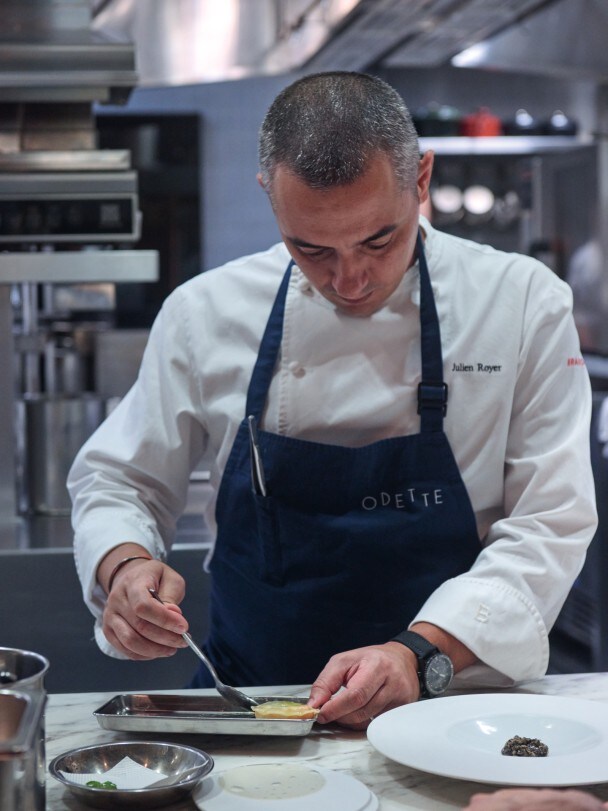
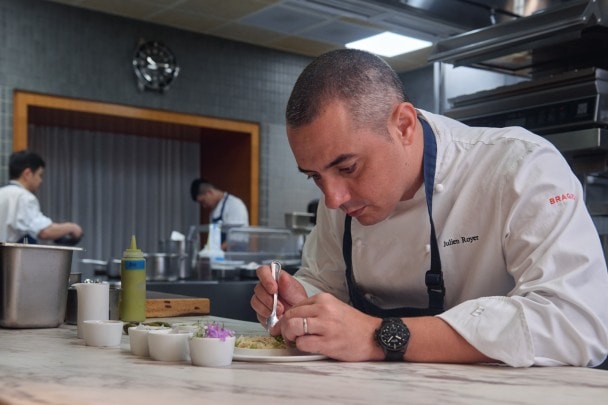
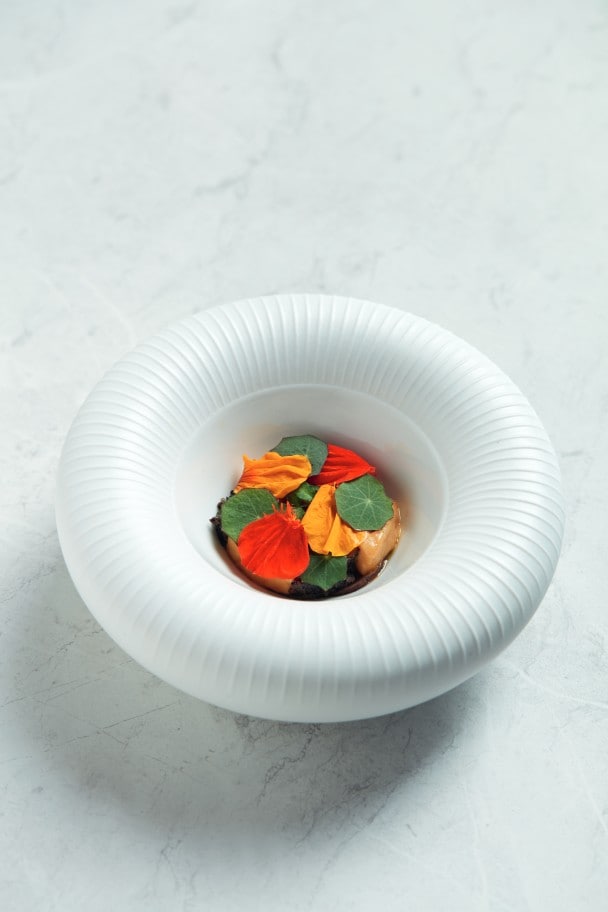
Chef Julien Royer puts the finishing touches on a ring of brown crab.
Wanderlust pointed him to a radical change of scene, St. Barths in the French Caribbean. Tropical ingredients and gastro creole became inscribed upon his resume. Then a dramatic U-turn. From the heat and sun of the Caribbean to the resort of Meribel, the middle village in France’s famed Trois Vallées ski resort. Here he perfected his fish cooking skills.
Back again to the sun, two plus years in Bora Bora in French Polynesia. Thence, to London’s Mayfair and the Greenhouse restaurant.
After the zigs and zags from rural France, to sun, to snow, to remote resorts, then to a large city, Royer found his calling in Singapore, recruited to the kitchen of restaurant Jaan. He saw his opportunity to go out on his own when space became available in Singapore’s restored National Gallery. The National Gallery is a gem consisting of two former government buildings; one wing former offices, the second, where Odette is now located, an historic courthouse.
Opening his doors in 2015, Royer had one advantage: he had already spent time in Singapore, thus, he had the beginnings of a list of suppliers. The challenge for new arrivals otherwise would be forbidding. The brutal reality is that Singapore has no food resources to speak of; everything originates outside of the city/ state. No less than the late Joël Robuchon, the most revered chef of our time, exited Singapore unable to construct a sufficient network to support a planned restaurant. Royer has navigated the challenges of suppliers by cleverly straddling his native France for certain products and others where he has discovered sources ranging from Southeast Asia to the far north of Japan and Korea. As he expresses it “the world is Singapore’s market”. Adaptation has been his watchword. For some supplies, dazzlingly succulent Brittany pigeons, his native chesses, truffles, foie gras, Royer turns to France. Traditional French seafood…turbot, bar, rouget, durade, sole…all out of the question as even supply via air would take too long. Fortunately, the cold waters of Northern Japan offer a bounty of alternatives such as Shimane Amadai and Bafun Uni (sea urchin) that work perfectly with French techniques. Indeed the range of shellfish from Japan is vast: scallops, langoustine, lobster, oysters. For produce and spices he has located artisanal farmers in South-east Asia. Indeed, in some cases he has located alternatives that he prizes as superior to traditional French ingredients. One example is Cambodian pepper which he can obtain with three different levels of maturity, which when combined in a dish, yield greater complexity than classic black pepper. A sign of Royer’s devotion to quality suppliers: in the same way that today we celebrate celebrity chefs, he believes we should similarly honor what he would call “celebrity farmers” or “celebrity fishermen” or “celebrity éleveur”.
Although he has acclimated, so to speak, to his South-east Asia environment, Royer is adamant that his cooking is resolutely French and, most certainly, not fusion. As he puts it, it is French “seasoned” by Asia. In but four years, a remarkably swift ascent, Royer was awarded the ultimate accolade from Michelin with the award of three stars in 2019, a perch he has occupied without interruption since. Further confirming his talents, in 2019 and 2020 he was crowned with the title “Best Restaurant in Asia” and, on the list of the 50 Best Restaurants, placed number 24 in the world.
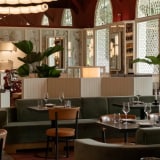
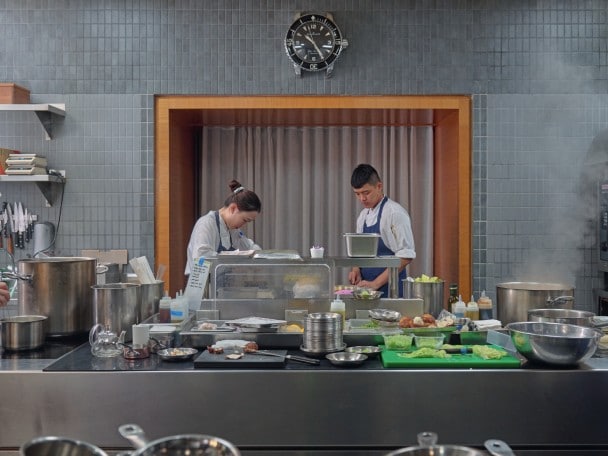
Entering Odette one immediately senses that a three star experience awaits. Tables are widely separated, many tucked into small alcoves. The ambiance, understated elegance. An armada of amuse-bouches sounding the overture to the tasting menu playfully features: a small soup terrine topped by a wooden dome so as to mimic a mushroom form and, indeed, enclosing exactly that, a cèpe sabyon with toasted buckwheat and walnuts served alongside a fine filigree of dried cèpes atop a mini brioche; of all things, a tuna tartare taco with fried ginger (who would have imagined tacos in Singapore); a rich French onion, black licorice, coffee tartellette; and a shiso leaf with shimagi with a touch of yuzu kosho. These were followed by a second round: sea urchin on toast and caviar floating upon a dashi cloud of green apple/Japanese pear mousse.


The generous spacing of Odette’s tables.
The first course was a dazzler: a ring of Normandy brown crab surrounding a pool of snap pea velouté. The “ring” offered accents of small bits of pea, verbena and finger lime. Every forkful brought new dimensions of texture and flavor: smooth, crunch, sweet, citrus.
This was followed by a dish Royer considers one of his signatures: a langoustine dumpling. A brilliantly fresh and sweet langoustine with a shiso leaf was packaged in the dumpling, which resembled a large ravioli, set upon a leek confit, the ensemble surrounded by a deep rich beurre noisette flavored with vin jaune and a pork/veal demi-glace. In all respects a true triumph.
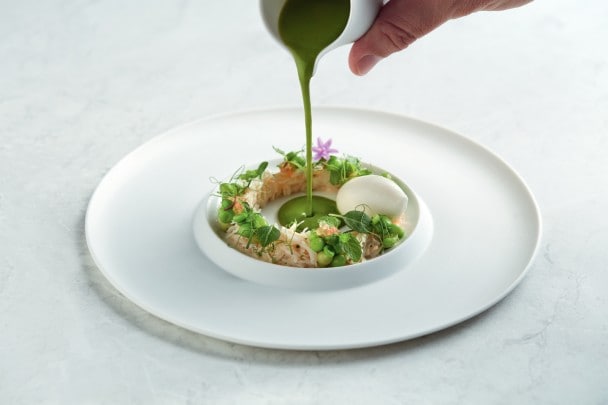
The final touch to the brown crab, the snap pea velouté.
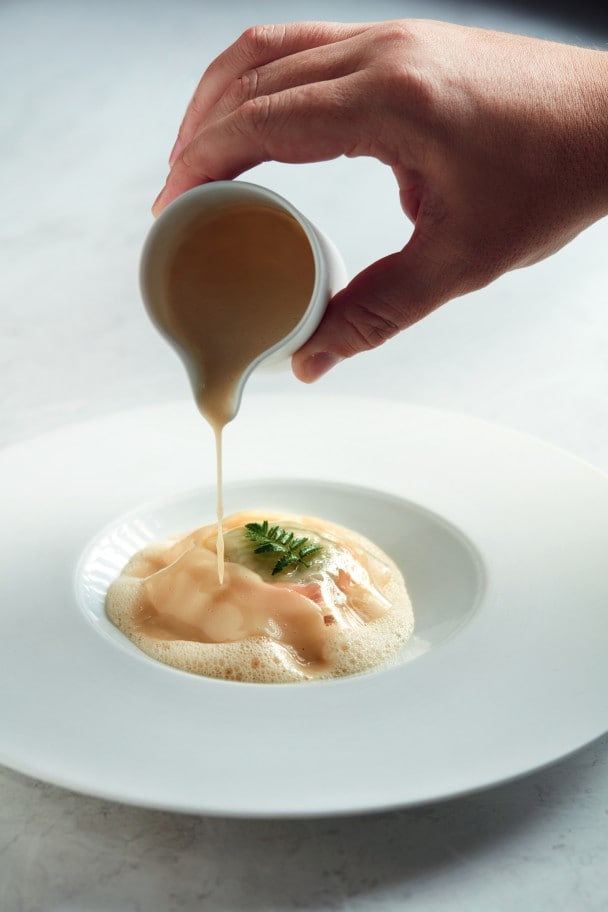
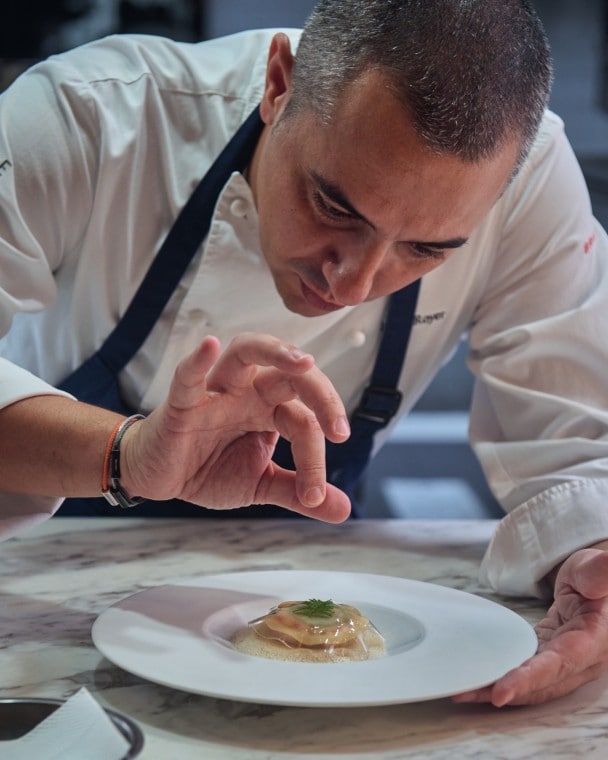
Royer’s langoustine dumpling.
A riff on surf and turf was next up. Paired were duck foie gras from France and abalone cheeks from Korea. The play on textures was entertaining, as the foie gras morsels offered a cloud like texture contrasting with the slightly gelatinous chew of the abalone. Both were floated in a ginger infused pork broth accented by shiitake and yuzu.
Royer blended cultures in the fish course. Shimane Amadai, a Japanese variety of sea bream, was cooked tempura style served upon a bouillabaisse sauce bridged to Asia with accents of coconut, kafir lime and Thai basil. The sauce was magnificent as the coconut brought an entirely original spin on the traditional bouillabaisse flavors.
Pigeon has become an emblem of Odette and, of course, Royer mentions it prominently when asked to list his signatures. The star is, of course, the pigeon, sourced from an eleveur in Brittany. In keeping with Royer’s devotion to his suppliers and his conviction that they have earned a spot in the limelight, the pigeon leg, served alongside the cooked perfectly rare breast, bears a message wrapped around its tip with the name of the French eleveur, Fabien Deneour. These Brittany pigeons, raised specially for Royer, are fed a unique diet based on chestnut flour. Not only are the birds impressive in size, the meat has a magnificent texture and no hint of the livery flavors the one finds in pigeons of lesser pedigree. Royer seasons the pigeon with three different maturities of Cambodian pepper. The sauce, an intense pigeon reduction. Of course, the centerpiece is the generously sized breast meat, but that is not to diminish the importance of the pancetta/pea stuffed leg and, in a nod to the Chinese influences on Singapore culture, a pigeon bao. Michelin defines its three star rating as signifying a restaurant worthy of a journey. Royer’s pigeon, alone, merits the long voyage to Singapore.
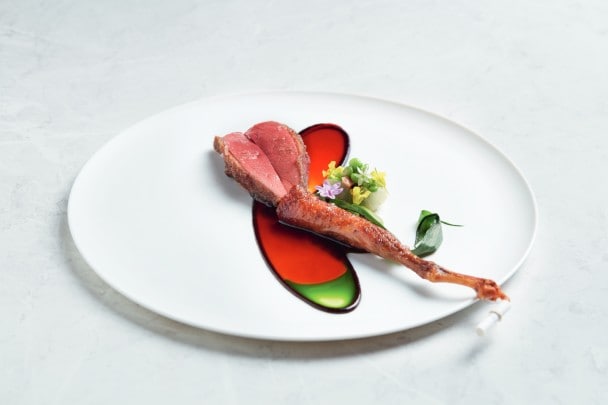
Royer’s signature pigeon.
Foie gras and abalone.
After the richness of the pigeon, Royer refreshed with a sorrel-pineapple sorbet, Thai basil granité accented by bits of kiwi.
Presiding over Odette’s desserts is Louisa Lim, who in 2023 was crowned as Asia’s Best Pastry Chef. On this evening, she prepared what she described as a Grain de Café, her interpretation of tiramisu. Banish the thoughts of the gooey soggy desserts often called tiramisu. Hers was constructed in layers, cake on the bottom, the amaretto sauced gelée above, all topped with a coffee dusted crisp. In short, grown up tiramisu.
Julien Royer has a second restaurant in Singapore, named “Claudine” after his mother. Located on a hill somewhat distant from the city center in a converted 1930’s chapel, Claudine is more casual than Odette with a neo-brasserie vibe. The cuisine strongly hews toward classical French inspired by honest homecooking. The menu is a “who’s who” of French classics: escargots, foie gras, jambon persillé, caramelized onion tarte, steak frites, pepper steak flambé, bouillabaisse, coq au vin, choux farci. The jambon persillé shows the Royer touch, bringing an extra sparkle to this Burgundian specialty. In place of the usual ham, Royer built his version with kurobota pork. The parsley gelée is particularly impressive with its almost radiant green color. The pepper steak flambé offers a bit of tableside theater with its flaming cognac sauce accompanying the Angus ribeye. Creativity does not end with the starters and mains. The île flottante dessert is particularly impressive, albeit a bit worrisome when first presented. Classically, an île flottante features a meringue “île” floating upon a pool of crème anglaise. Royer’s version arrived with a meringue column but no crème anglaise to be seen. Puncturing the column released the anglaise which had been hidden in the interior.
A word about the wine lists in both Odette and Claudine. Not only did they offer the landmark Bordeaux and Burgundy names, they included two Swiss wine domaines: Daniel Gantenbein and Marie-Therese Chappaz. Both are reference points in Switzerland and nearly impossible to find even within the Swiss borders as each year’s vintage is sold out long before release. A pleasant surprise to find these two personal favorites appearing on a Singapore wine card!
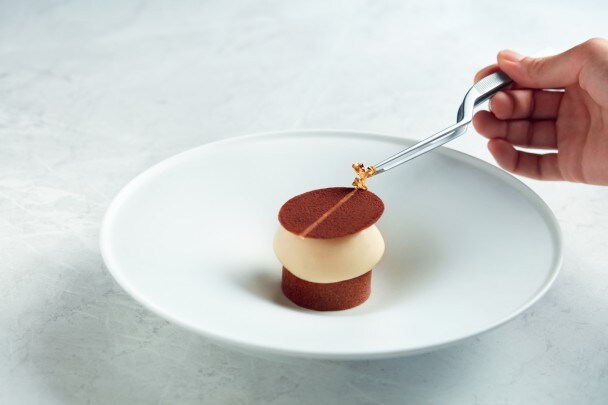
Pastry Chef Louisa Lim’s unique interpretation of tiramisu.
PUBLISHER EDITORIAL COMMITTEE PROJECT MANAGEMENT EDITORS IN CHIEF CONTRIBUTORS TO THIS ISSUE | GRAPHIC DESIGN. LAYOUT ART DIRECTION WATCH PHOTOGRAPHY OTHER PHOTOGRAPHY, ILLUSTRATIONS Release date: January 2026 |